
Nature as the next alternative asset class
Investors have long sought alternatives as a diversification strategy to manage the volatility of public markets. Alternative sectors outside of listed equities and fixed income include private equity, infrastructure, real estate and more unique things like art, intellectual property portfolios (such as music rights) and vintage cars. The appeal of these sectors lies in their non-correlation with public markets, inflation protection, and illiquidity premiums.
Now, these same features are being seen in nature and biodiversity credit markets. After several decades of growth and development, newly signed UN agreements have driven global policy to enable nature to emerge at scale as a viable alternative asset class.
Nature as an investible asset
Approximately half of the global economy moderately or heavily relies on nature. For example, much of our agriculture and clean water relies on natural processes occurring in the environment. Historically, the cost of damaging nature has been externalised to society: the companies clearing land or polluting the atmosphere did not pay for this damage. Rather, broader society paid for it with increased healthcare costs from polluted air, or more expensive groceries from less efficient agriculture due to disturbed water regimes or pollinators.
However, governments and voters are increasingly demanding that these costs be internalised to the ones doing the damage. For example, the NSW Biodiversity Offset Scheme requires any land clearing to be accounted for by purchasing government regulated like-for-like biodiversity credits, which assign value to improvements in habitat and ecosystem function.
Just as carbon markets evolved from policy tools into tradeable assets, biodiversity credit markets are on the same trajectory. In the NSW market, anyone can invest to generate credits or trade credits from projects funded by others - you don’t need to be the one causing the damage to do so. As more participants invest in these markets they become increasingly liquid, making it easier for biodiversity project developers to obtain the finance required to complete conservation. These market dynamics have enabled nature to emerge as an investible asset class with profits to be made.
Nature’s investment characteristics
Nature exhibits many of the desired characteristics of traditional alternative assets:
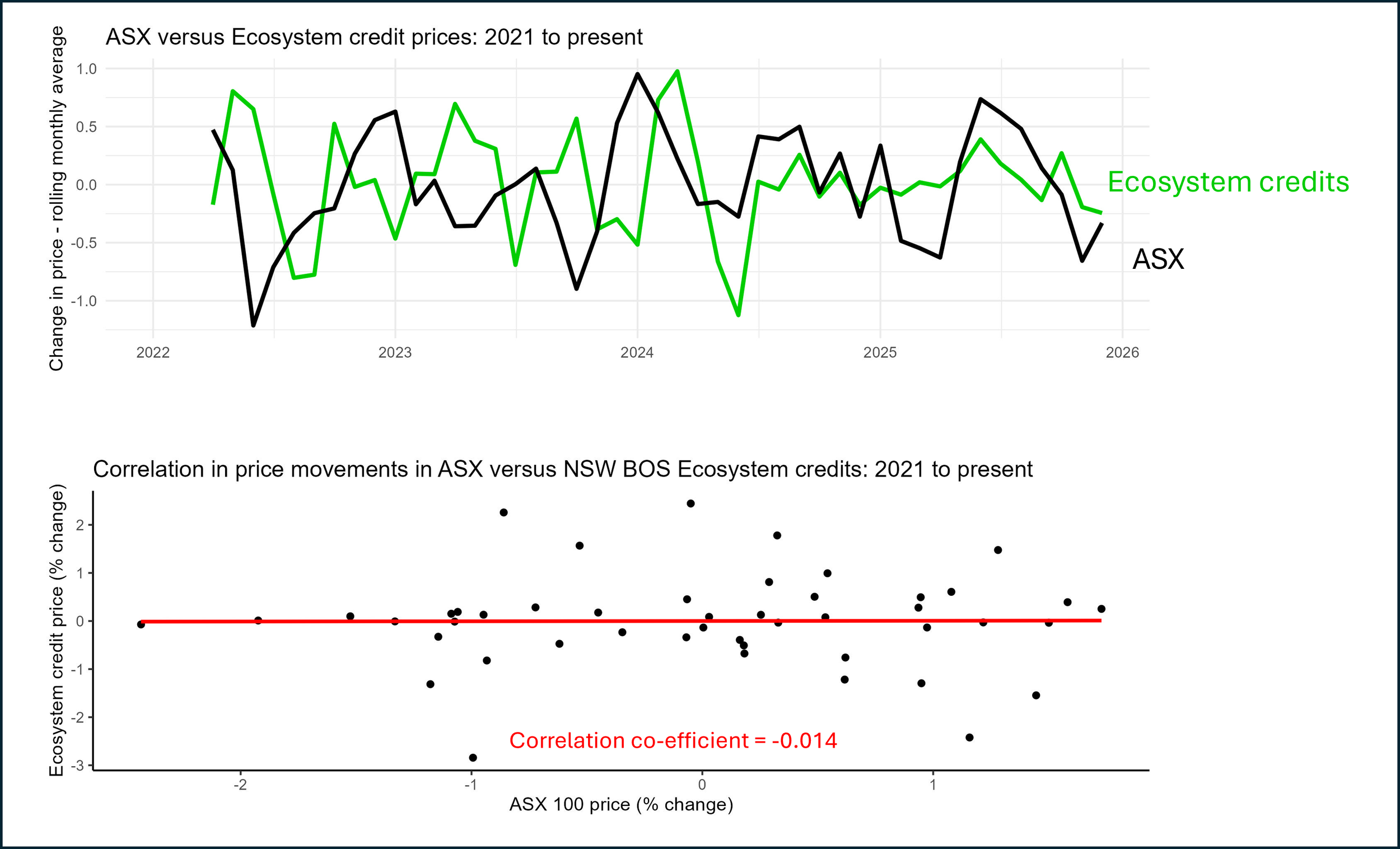
Low or no correlation with traditional financial markets: Returns derive from ecological, regulatory, and project-level drivers, not market multiples. Our analysis shows no correlation between the NSW Biodiversity Credit Market (green) and the ASX (black), with a correlation co-efficient (red) of -0.014:
Long duration and inflation linkage: As restoration costs rise, the market value of biodiversity credits tied to those costs also rise.
Impact alignment: Opportunity to generate measurable environmental and economic returns while balancing portfolios against traditional market correlation.
For investors seeking more than paper returns, nature may deliver what other asset classes cannot.
Market signals
Momentum is building fast. Globally, there is increasing uptake of nature-positive regulations and Bloomberg New Energy Finance forecasts the biodiversity credit market could reach USD 160 billion by 2030. Natural capital funds and blended finance vehicles are also attracting institutional and family office interest.
Crucially, developer obligations, corporate target setting, and regulatory regimes are creating sustained demand for high-integrity credits and restoration projects. First movers will secure pricing advantages, influence standards, and access high-quality assets.
References
World Economic Forum. (2020). Nature risk rising: Why the crisis engulfing nature matters for business and the economy. https://www.weforum.org/publications/nature-risk-rising-why-the-crisis-engulfing-nature-matters-for-business-and-the-economy/
BloombergNEF. (2024). Biodiversity Finance Factbook: COP16 Edition. https://assets.bbhub.io/professional/sites/24/Biodiversity-Finance-Factbook_COP16.pdf
